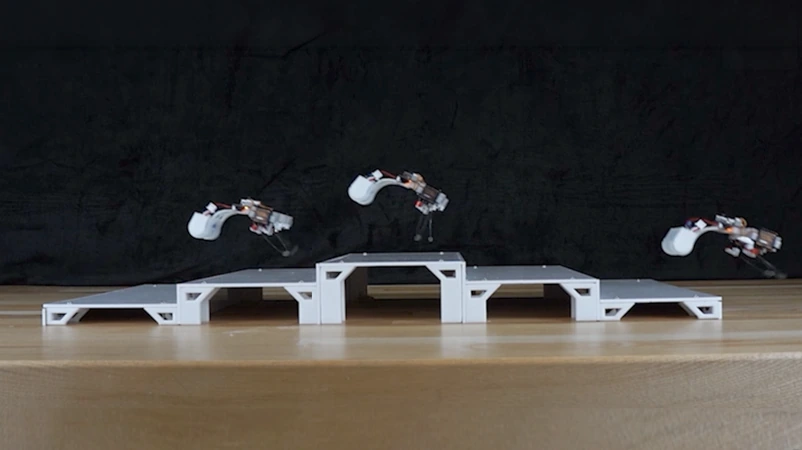
Engineers at the University of California, Los Angeles and the University of Michigan have built a robot that stores energy in elastic rods and releases it to hop. The prototype weighs 98.2 grams.
A small motor bends and twists the rods. Once the deformation reaches a critical point, they snap into a new shape and push the body forward. The mechanism produces a brief, powerful impulse from a low-power motor.
In experiments, the robot moved across wood, fabric, acrylic, leather, grass and sand, and climbed small steps. On all six surfaces, the version with elastic rods was faster than a version with rigid supports.
With thin, flexible fins attached, the same prototype could swim, turn and avoid obstacles. The researchers also tested its steering in a sandbox containing rocks.
The work was published in Science Advances. The device remains an experimental prototype: the team tested a movement mechanism, rather than presenting a robot ready for everyday use.