Researchers tested perovskite solar modules 10 metres underwater near Weizhou Island in the South China Sea. Over two hours, the devices generated 324 milliwatt-hours of energy, equivalent to 0.324 watt-hours.
Harvesting light underwater
The work was carried out by a team led by Wen-Hua Zhang of Yunnan University and Southwest United Graduate School. Sunlight weakens rapidly underwater and its spectrum changes. The researchers selected perovskite cells able to use light ranging from blue to orange.
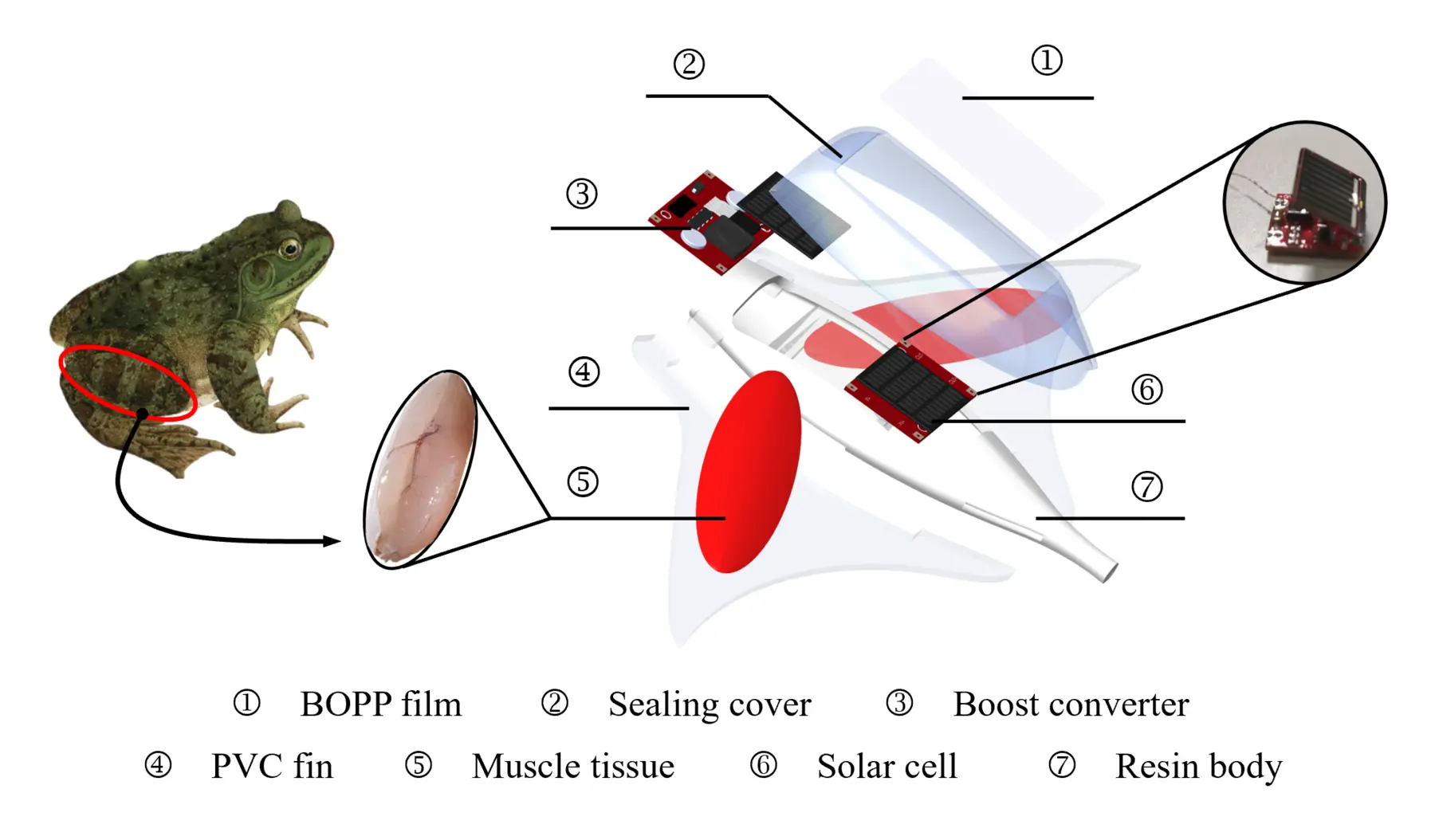
They first reproduced lighting conditions at different depths in the laboratory using optical filters. The modules were then mounted on underwater robots and tested at sea. The harvested energy was used to charge lithium-ion batteries.
Durability was assessed separately. After 300 days of storage in nitrogen, the cells retained about 96% of their initial efficiency. A 1,160-hour laboratory test simulating the light available at a depth of 10 metres also showed little degradation.
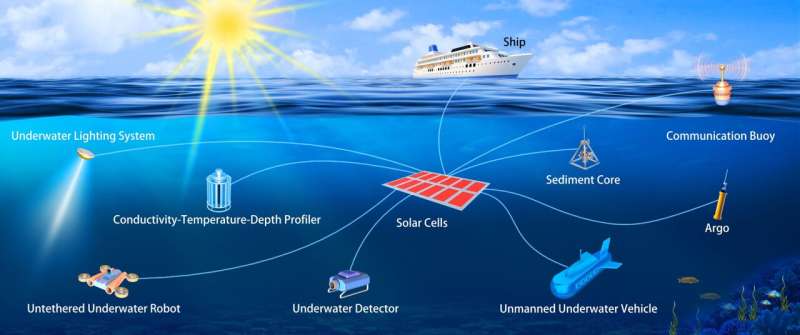
The sea trial lasted only two hours. Practical use will require tests at greater depths and standardised evaluation methods. The authors see potential for powering underwater sensors, cameras and communications equipment. The findings were published in Joule.