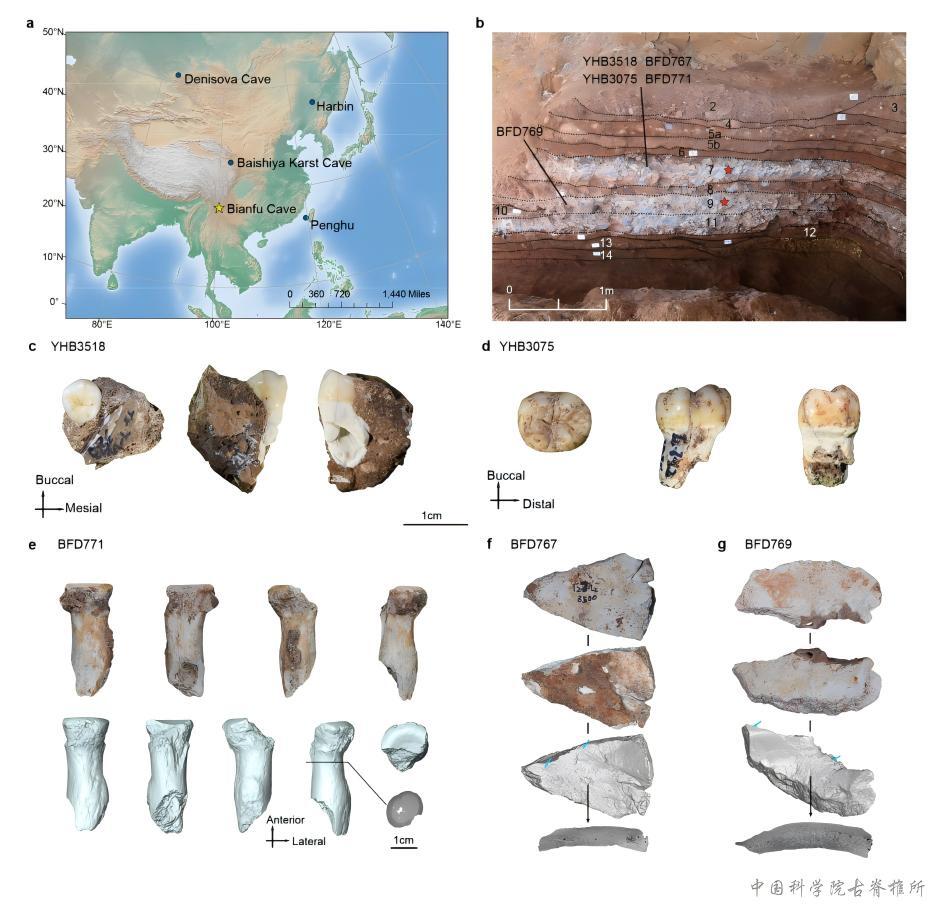
Researchers have identified five Denisovan fossil specimens in Bianfu Cave, in China’s Yunnan province. They include the first known fragment of a radius, one of the two long bones in the forearm, attributed to this ancient human group.
Ancient humans identified through proteins
The work was carried out by a team led by Fu Qiaomei of the Institute of Vertebrate Paleontology and Paleoanthropology at the Chinese Academy of Sciences, together with other research institutions. The study was published in Nature on September 9.
The researchers screened more than 60,000 bone fragments from the cave. Analysis of preserved proteins identified two skull fragments, part of a radius and two teeth as Denisovan. The specimens come from layers dated to approximately 167,000 to 134,000 years ago.
Denisovans were ancient relatives of Neanderthals and modern humans. Few of their remains are known, so researchers still cannot reconstruct their physical build in detail.
Why the forearm bone matters
The fragment combines different anatomical traits. Some features resemble Neanderthal bones, while its overall external shape is closer to that of modern humans.
The authors say the find provides new evidence about Denisovan anatomy and extends their confirmed geographical range in Asia. However, a single fragment cannot reliably reveal the group’s complete appearance or everyday behaviour.