
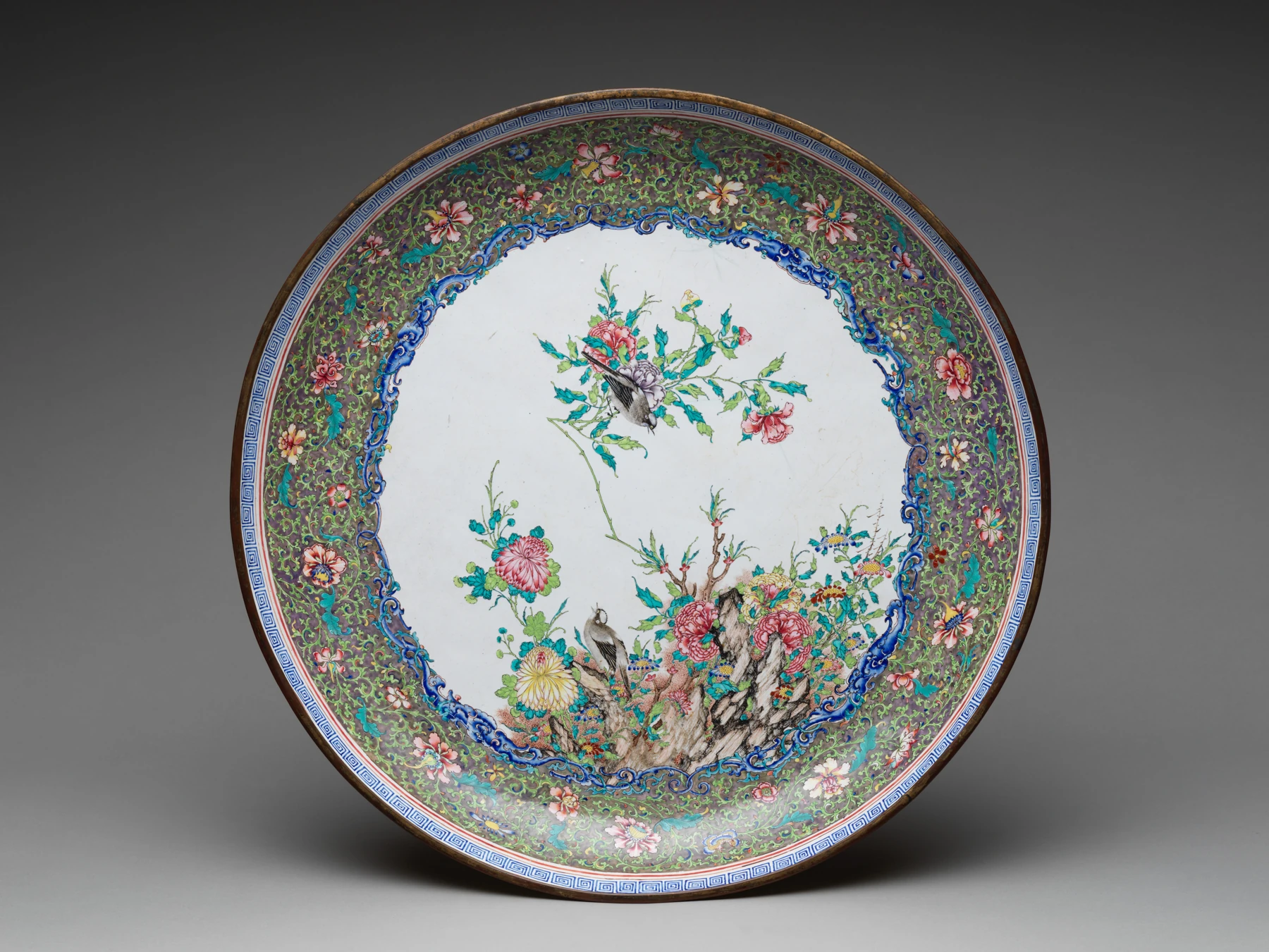
The Fitzwilliam Museum in Cambridge is presenting An Enamel Revolution: China and the World, a display tracing the development of Chinese enamels. It is jointly organised with the Art Museum of The Chinese University of Hong Kong.
The focus is on workshops that developed new ways of decorating porcelain, glass and copper from the seventeenth century onwards. Makers experimented with materials and colour, adapting their products to demand from Europe among other markets. A bowl or teapot can reveal the connection between an artistic choice and the handling of a material.
Canton (Guangzhou) played an important part in this story. According to the Metropolitan Museum of Art, the city became a centre for enamel production and distribution in the eighteenth and nineteenth centuries. Bird and flower motifs appeared across different kinds of objects, linking painted metalwork with porcelain decoration.
Seen together, such objects soften the familiar boundary between art and technology. Achieving a particular colour and surface required knowledge of materials; finding buyers abroad required an understanding of different tastes. The display can be read as a history of those decisions, preserved in everyday objects.
The display is open in Gallery 26 from 20 October 2026 to 21 February 2027. Admission is free and booking is not required.