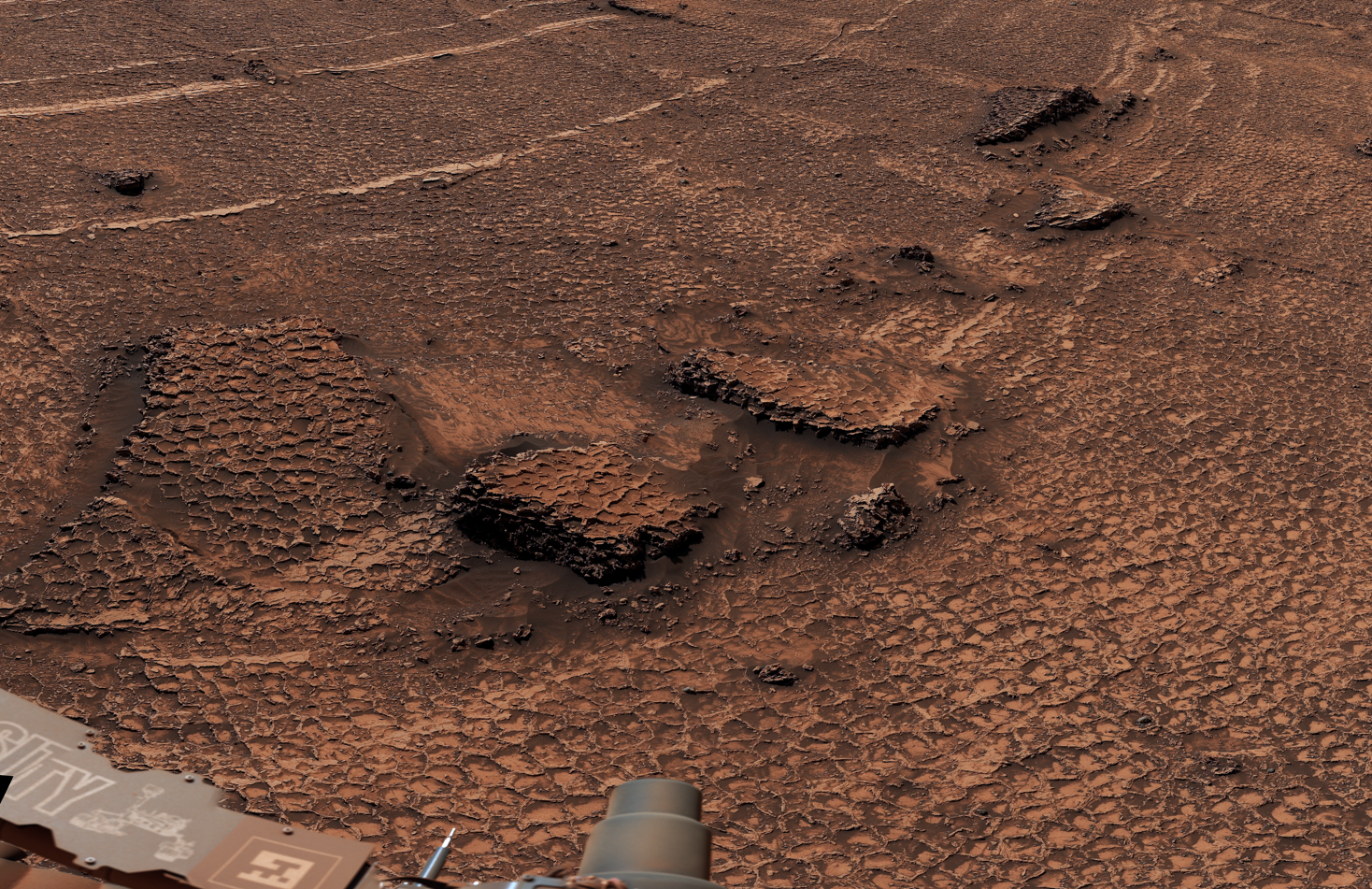
On June 19 and 20, 2026, mission sols 4,930 and 4,931, Curiosity captured a 360-degree panorama while climbing a valley nicknamed Valle Grande. The polygonal fractures extend in every direction and wrap around the slopes of Miraflores, a nearby butte about six metres high.
A pattern on a new scale
Curiosity had previously encountered small patches of similar geometric features, but never so many in one place. NASA puts the individual polygons at roughly 4–8 centimetres across. The Mastcam panorama was assembled from 340 images transmitted to Earth.
What the polygons could reveal
Such patterns can form when a surface dries and cracks, through repeated warming and cooling, or when buried sediment is compressed and loses water. The mission team is comparing the polygons’ geometry and chemistry to identify the most likely process.
The field is not evidence of life by itself, but it may help reconstruct the water and climate history of ancient Mars.