
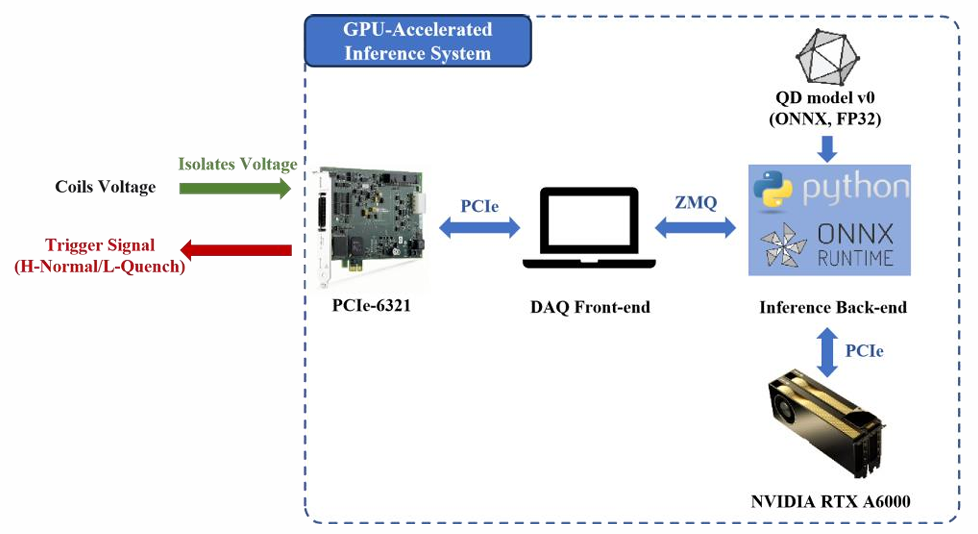
Researchers at the Chinese Academy of Sciences have developed a system that distinguishes a loss of superconductivity in magnets from similar electromagnetic disturbances. They tested the technology on a prototype for the HIAF accelerator facility.
Superconducting magnets are used in particle accelerators and fusion research devices. When a region of a magnet loses superconductivity, it heats up rapidly. Protective measures must be activated within tens of milliseconds to prevent damage.
Magnetic disturbances complicate detection: their electrical signals can resemble the onset of a quench and trigger false alarms. Researchers at the Institute of Modern Physics trained a neural network to distinguish the signals using data collected over several years.
During testing, the system identified all three quench events against a background of more than a thousand magnetic disturbances. According to its developers, signal processing takes milliseconds.
The findings were published in Superconductor Science and Technology. The tests used a prototype magnet; applying the system to other scientific facilities will require further validation.